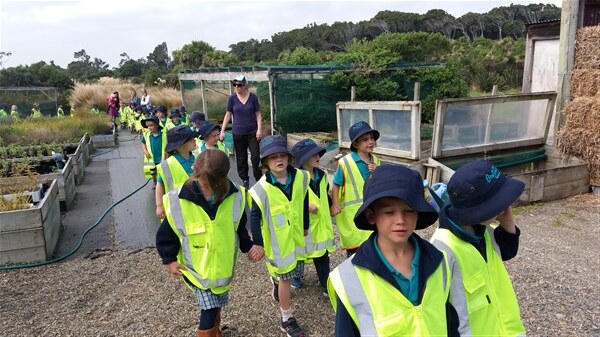
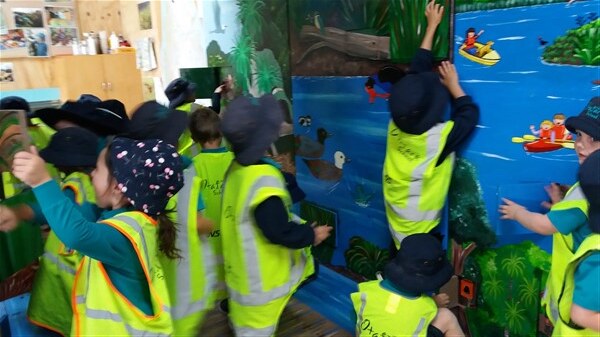
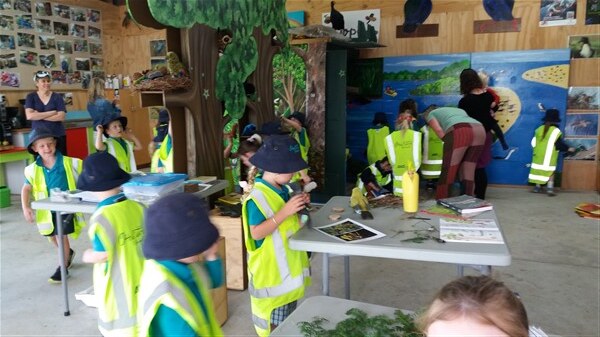
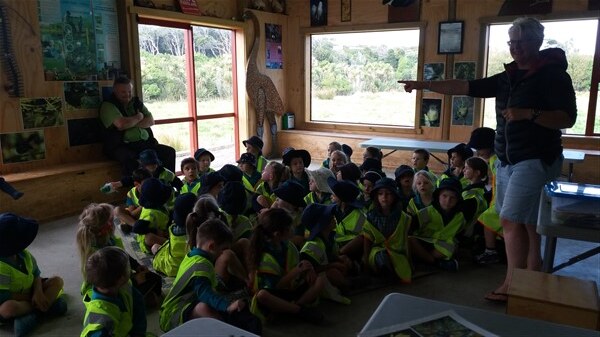
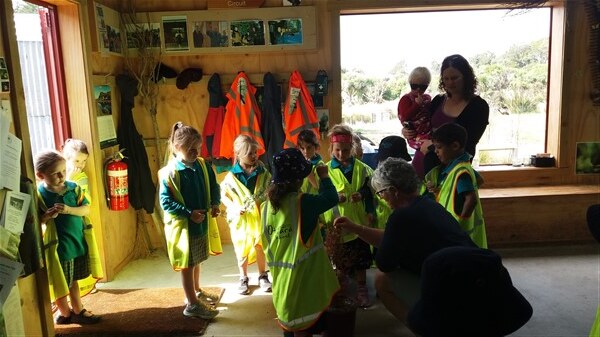
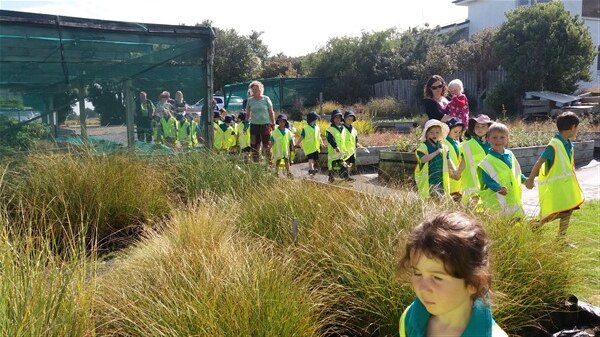
The procession of Otatara School classes to the Southland Community Nursery continued today with the new entrant/ year 1 rooms 1 (Kowhai), 2 (Miro) and 3 (Matai) visiting today. Around 40 excited children walked through the apple orchard, then checked out the tunnel in the education centre seeing what kind of plants and animals can be found living in different Southland habitats.
Having three classroom trees to focus on and learn about saw us concentrate on looking at leaves and identifying which plant is which. We noted that kowhai have little round leaves, yellow flowers and seeds, Miro looks like a comb and has big red berries, and Matai is the scruffy “ugly duckling” of a tree as a juvenile (or baby). It was also noted how beautiful a Matai is as an adult tree! It also became apparent that room 3 have the wrong potted plant in their room so their mission is to go on a treasure hunt around school to find the Matai. We also listened to the tui, bellbird, and Kereru (soft toys with sounds) as the birds that are closely associated with these tree species, in particular with Kereru being the only bird able to eat and distribute the big Miro berry. We also talked about the paintbrush type tongues that the tui and bellbird have to help with drinking nectar from the likes of kowhai flowers. Information about attracting birds to your garden can be found at the Community Nursery website link - https://www.southlandcommunitynursery.org.nz/restoring-your-patch/planning-your-project/attracting-birds/
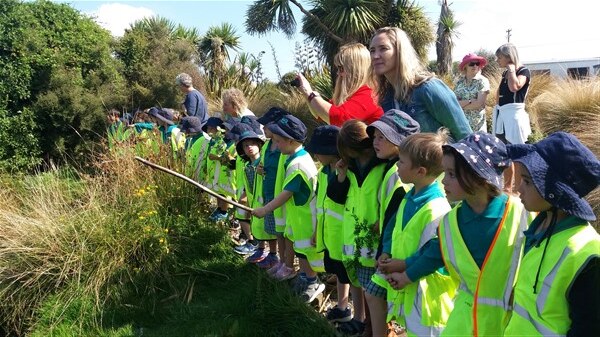
After directing the children to stand in two rows it was pointed out that all three of these classroom plants have leaves in two rows - how cool! I wonder if the classes will now line up like their classroom plant leaves? We walked down to the pond to check out a kowhai growing near the water and noting kowhai seed often fall into the water which helps them grow when they reach land. Most of the children thought the pond had always been there, it looked so nice and were surprised it had been “made”. We then headed back to the bus. We look forward to seeing these classrooms next time and having fun with the many activities we offer at the Southland Community Nursery. Thanks also to Katrina Ferns who came along to help.
Bronwyn and Chris
Posted: 21 March 2019
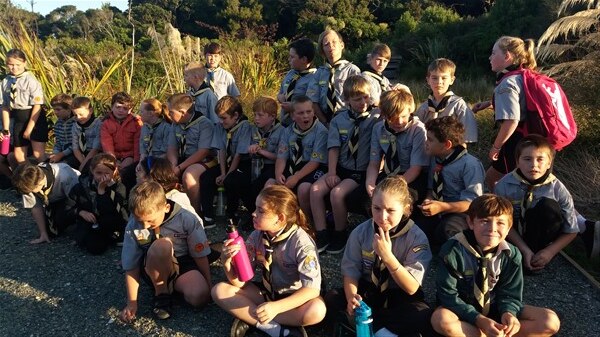
A small group of Keas, their leaders and parents arrived at the nursery to work on their Conservation Badge. We found out all about Nestor Notabilis (the kea) including where it lives, what it eats and its cheeky characteristics.
Then we played a game guessing the sound Keas make - not the kingfisher, karearea, nor piwakawaka!! We also noted how different the kea beak was from these other birds.
Then it was off to the bush to collect some mingimingi seeds and looking at the nursery spider nest (and a photo of the adult spider Chris had seen in the morning on the nest) while they learnt about the Kiwi Conservation Club. A great night.
Bronwyn and Chris
Posted: 19 March 2019
The learning about classroom plants continued with room 5 of Otatara School visiting the Community Nursery and Education Centre. Firstly we distinguished between Punga (a collective term used to include all tree ferns) and Ponga (the specific Maori name for the silver fern). The Ponga or silver fern doesn’t grow in Otatara but the wheki ponga does. The classroom came with lots of knowledge from their inquiries so far and they shared this with us. We then did a range of activities in the education centre starting with a game where we grouped ferns and talked about whether they are found naturally in Otatara - Wheki (hard treefern), Wheki Ponga (fibrous tree fern) and Katoke (soft treefern) are. Then we looked closely at the spores of fern leaves that Chris had collected from our NZ native bush and saw first hand that ferns do not have seeds, but have “spores”. We also learnt that different ferns have spores in different places, which is something that helps group ferns. Then it was off on a walk exploring the bush looking for ferns and wondering why they grow in certain places and not others. Our walk confirmed that ferns like shady sheltered places to grow. During our walk we also noticed many of the other classroom plants and had a very friendly piwakawaka follow us looking for the bugs we disturbed. We then talked about how difficult it is to age tree ferns (as opposed to tree ring counting) but that many tree ferns seen would be very old – the oldest can grow to 100 years old.
Great enthusiasm and lots of great questions made it a fun time. It is great to see the local school connecting with their local environment.
Bronwyn and Chris
Posted: 19 March 2019
While it rained heavily outside we stayed in the Education centre and had fun guessing which of the 5 seedlings potted up and sitting on the table was Pokaka.
Students used the shape of the leaves, colour of the leaves, the size of the seedling to make their identification choice. It was revealed that two of the five were Pokaka, one native jasmine and two Melicytis. How similar these plants look as juveniles! Then we looked at leaves to identify which were Pokaka. We talked about botanists, and classification and naming of plants, learning that Pokaka (Elaeocarpus hookerianus) is named after a person. We also got an indication of how difficult plant identification can be, especially when a plant is heteroblastic (has a different adult from juvenile form). Then it was out to the bush track where we saw an adult Pokaka with seeds on it. While in the bush we noticed all the seedlings growing…and again the students used their identification skills to pick out Pokaka, from jasmine and lancewood seedlings. This class is really getting to know their classroom plant.
Then it was back to the newly formed track and viewing seat where we pondered how forests are formed, looking at the different layers of a forest – that which was dominated by nursery or colonising species (like those grown at the Southland Community Nursery), and the canopy layer where we saw Pokaka, kahikatea and other canopy species. Back at the Education centre we looked at the Otatara School classroom plants and as we named them we talked about notable identification features. There was then one plant at the door to the education centre – what was it? Hmmmm…. we gave the hint that it was also a classroom plant…….Pokaka!!! That’s right – your classroom plant!….. It was great to have this year 5 and 6 class and it was great to see the students making their own notes on their learning. We look forward to having them back for their next visit.
Bronwyn and Chris
Posted: 19 March 2019
On a warm evening March 12, nearly 40 Georgetown Cubs plus their leaders and helpers descended on the community nursery for a night of learning about the environment. We headed down the newly formed track and as we did an arm raised indicated silence (and for a group of this size we were impressed). There was a fernbird chirping nearby and some of us heard it. We introduced the threatened fernbird to this eager group and they learnt about its secretive habits, the habitat where it likes to live and what is being done to help this species (pest control and habitat creation). This group was the first group to use both the new path and the seat which is in a perfectly situated place to talk about some of the changes that have happened to the environment - both the vegetation clearance, and revegetation and habitat creation. Walking through to Bushy Point we talked about how communities can become involved in projects, and looked at just how a pest trap can work. Then back at the community nursery is was a team effort by the Sixes to collect as many mingimingi berries as they could to help out the nursery with this seed collecting. It was then fun to say Coprosma propinqua (mingimingi) 10x fast! A great night to be learning about the environment and great questions asked by this group.
Bronwyn and Chris
Posted: 19 March 2019