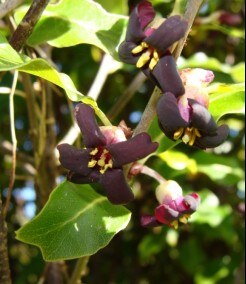
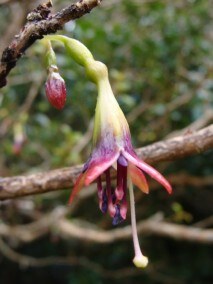
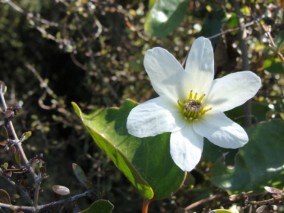
Spring is such an exciting time with so many plants flowering - just a few of the most spectacular are native clematis, tree fuchsia and kohuhu.
There are nine native clematis in New Zealand, the most common in Southland is the large flowered Clematis paniculata. In October you will see flowers climbing through to the canopy. Clematis have male and female flowers on separate plants - the female flower being much smaller than the male and only the female flower will produce seeds. Tree fuchsia (Fuchsia excorticata) is one of the best plants for nectar feeding birds. The tui and bellbird thrive on the delicate flowers which often form before new leaves are produced in very early spring. Fuchsia go on producing flowers for much of the summer and so provide a continuous source of nectar for native honeyeating birds. Kohuhu (Pittosporum tenuifolium) is a very common native plant used for shelter and restoration planting. In early spring it is covered in small dark pink flowers that are delightfully scented, especially on warm calm evenings. Other, much rarer native scented plants are Olearia polita and Olearia fragrantissima. Olearia poilta has tiny white flowers in October while Olearia fragrantissima has larger yellow flowers in November - both are highly scented, smelling of peach or apricot - a must for any native garden.
Posted: 17 October 2011
Spring in the nursery is the most exciting time! All of the seeds sowed before winter should be germinating and the time for pricking out and potting up is a busy one as we try to get as much out of the short Southland growing season as possible. Hopefully, over winter you have been planning what plants you would like to plant out and therefore have a plan of how many plants you need and which species you want to grow. If you havent, don’t worry - just come to the nursery on a Friday morning and we can talk it through. Or visit the Community Nursery website and get an idea of the plants that grow best in Southland.
On the afternoon of 26 November 2011 we will be having a Community Nursery Open Day where you can see the nursery, restoration area and created wetlands. It’s an opportunity to ask any plant questions -natives, fruit trees, weeds (bring along a plant (native or weed) for us to identify if you don’t know what it is). There will be some give-away native plants and lots of ideas.
Posted: 17 October 2011
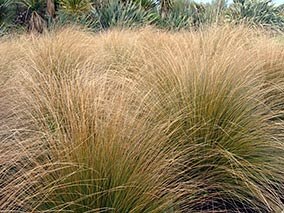
Red tussock was once very widespread in Southland. It grows naturally in wet areas but is now more commonly seen as a landscaping plant. At the nursery we grow hundreds of plants from seed and they are available most of the year. Red tussock is a large grass-like plant that grows about 1 metre tall - its size makes it a very distinctive and dramatic plant to use for garden or wetland restoration.
Posted: 1 September 2011
In Southland, the flowering of the kowhai heralds the start of spring. There are up to seven different kowhai species, a number of which grow in Southland but Sophora microphylla (South Island kowhai) is the only one that grows naturally in Southland.
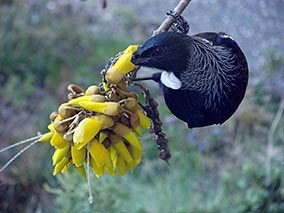
Every garden should include kowhai trees as they are the best plants for attracing honey eating birds into your garden. Tui and bellbirds are particularly attracted to the yellow flowers and acrobatically hang on the tree to get nectar out. Native wood pigeons feast on kowhai leaves often stripping branches bare (but they recover!).
South Island kowhai is naturally a tree of riverbanks - very few areas of kowhai lined rivers remain in Southland but at Kauana near Winton a covenant called “Kohwai Reach” is the best place to see kowhai in their natural environment. The seed of kowhai is very hard and requires soaking before sowing (in the wild, seeds would drop into rivers, soften and plant themselves further along the riverbank). Come and grow a kowhai at the Community Nursery.
Posted: 14 August 2011
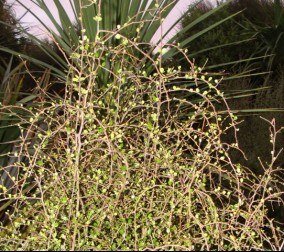
Weeping Mapou -Myrsine divaricata
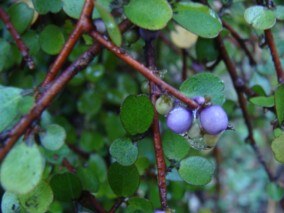
A small tree, with tangly braches and heart shaped leaves, it is distinctive for having a cascading “weeping” habit. This tree loves wet ground but as well as its form it rewards us in autumn with beautiful purple berries.
The photos do not do this plant justice so come along to the nursery and have a look - it is a must for every Southland restoration proje ct or garden.
Posted: 6 June 2011