
 Chris and Brian at Key Summit, Fiordland.New Zealand’s native plants are unique, having evolved in isolation for millions of years. About 80% of our trees, ferns and flowering plants are endemic (found only in New Zealand). Do your bit to help bring back native plants to Southland. You’ll not only help enhance the natural beauty of Southland, you’ll also help ensure habitat remains for our native wildlife.
Looking after your patch
Our natural habitats are complex and amazing. However, they are often threatened by clearance, invading weeds and animal pests. It is difficult to reproduce nature so it’s important to protect what we’ve got from further damage. Before embarking on a restoration project it’s important that protection measures have been put in place.
Find out more about what you can do to look after and protect your patch. Find out about the plant and animal pests that could threaten your hard work.
Find out about protecting your land for the future with a Queen Elizabeth II National Trust covenant.
Planning your project
 Pond excavation at Rance’s place, April 2004.Before embarking on a planting project it’s important to be clear about what you want to achieve. This will affect the size and scope of your project. For example do you want to:
- Enhance what you already have by restoring an area to a more natural state?
- Create a new area of natural vegetation, for example, by planting a paddock or creating a wetland?
- Attract native birds to your school, kindergarten or backyard?
- Use native trees as a shelterbelt on your property?
- Landscape your garden with native plants?
Find out more about planning your project and clarifying what you want to achieve at your patch.
Know your patch
Before you start planting you need to know what sort of habitat you have or want to recreate. This ensures you plant the right plants for your location. Find out about the six main habitat types in Southland and what’s best to plant in each:
Factsheets
Which native plants grow best in Southland? See our factsheets below for more information on plants suitable for restoration projects in Southland. Find out more about them, such as, where they like to grow, how much sun they need and how big they grow.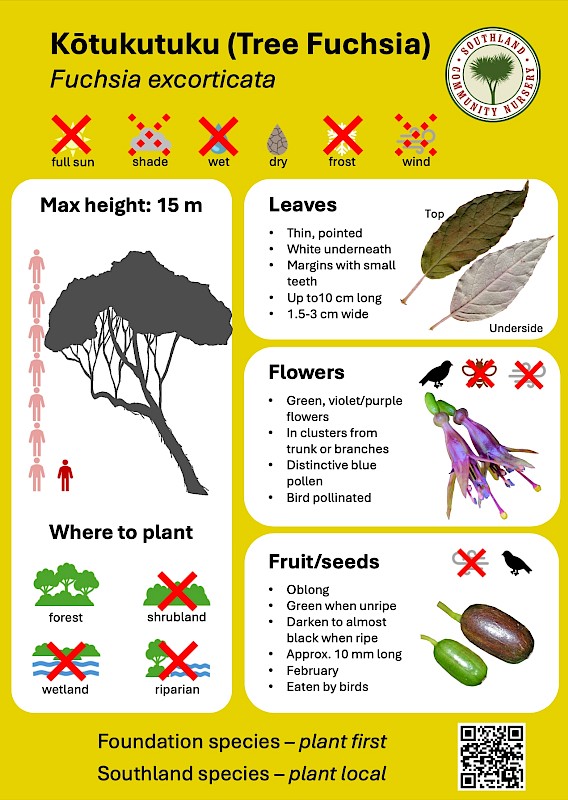 Kōtukuktuku (Tree Fuchsia) example factsheet.
See our key to symbols.
- Copper Tussock (Chionochloa rubra subsp. cuprea)
- Coprosma virescens (Coprosma virescens)
- Hall’s Tōtara (Mountain Tōtara) (Podocarpus laetus)
- Harakeke (Flax) (Phormium tenax)
- Horoeka (Lancewood) (Pseudopanax crassifolius)
- Kāpuka (Broadleaf) (Griselinia littoralis)
- Karamū (Shining Karamū) (Coprosma lucida)
- Kōhūhū (Black Mapou) (Pittosporum tenuifolium)
- Kōkōmuka (Coastal Hebe) (Veronica elliptica)
- Korokia (Wire-Netting Bush) (Corokia cotoneaster)
- Koromiko (Wollow-leaved Hebe) (Veronica salicifolia)
- Kōtukutuku (Tree Fuchsia) (Fuchsia excorticata)
- Māhoe-wao (Narrow-leaved Māhoe) (Melicytus lanceolatus)
- Makomako (Wineberry) (Aristotelia serrata)
- Mānatu (Ribbonwood) (Plagianthus regius)
- Mānuka (Tea Tree) (Leptospermum scoparium)
- Mingimingi (Coprosma propinqua)
- Mountain Wineberry (Aristotelia fruticosa)
- Native Broom (Carmichaelia petriei)
- Needle-leaved Mountain Coprosma (Coprosma rugosa)
- Pukio (Swamp sedge) (Carex virgata)
- Purei/Pukio (Ballerina Sedge) (Carex secta)
- Salt Marsh Ribbonwood (Plagianthus divaricatus)
- South Island Kowhai (Sophora microphylla)
- Tarata (Lemonwood) (Pittosporum eugenioides)
- Tier Coprosma (Coprosma dumosa)
- Tī Kōuka (Cabbage Tree) (Cordyline australis)
- Weeping Māpou (Myrsine divaricata)
Get growing, get planting
 Limehills School gets involved.Locally sourced (ecosourced) native plants are best suited to Southland conditions. They make attractive, low maintenance landscapes and bring in a wealth of native birds and wildlife.
Learn about:
- seed collection – what to collect and when
- seed propagation – how to make your seeds grow
- cuttings – how to take cuttings and make them grow
Find about the best way to prepare your patch for planting, how to plant your trees and how to protect them while they’re growing and establishing.
Threatened plants
Much of Southland’s landscape has changed significantly over the last 150 years or Olearia fragrantissima so. For example, on the Southland Plains, just 10% of the forest cover present in 1865 remains today. Many of Southland’s special indigenous plants are threatened by extinction.
Find out about Chris and Brian’s Threatened Plants Garden - a sanctuary for over 70 plant species native to New Zealand that face threat of extinction in the wild.
Check out our plant list and factsheets about threatened plants. See the NZ Plant Conservation Network to find out more information and photographs of the threatened plants found in Southland.