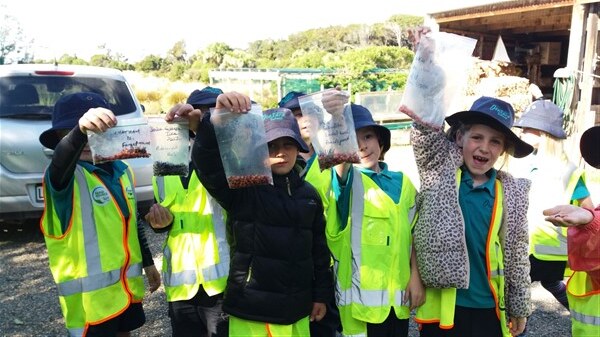
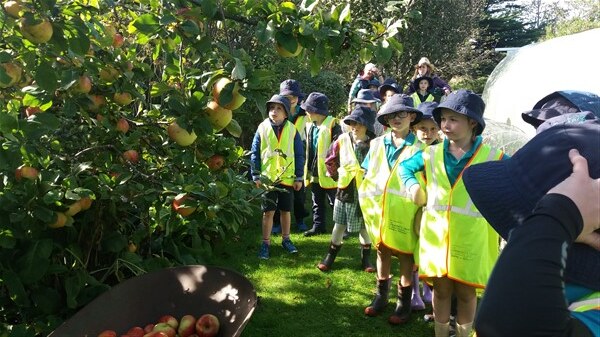
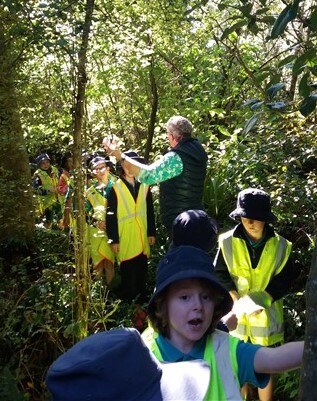
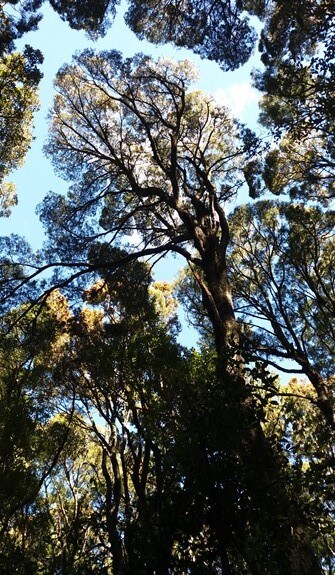
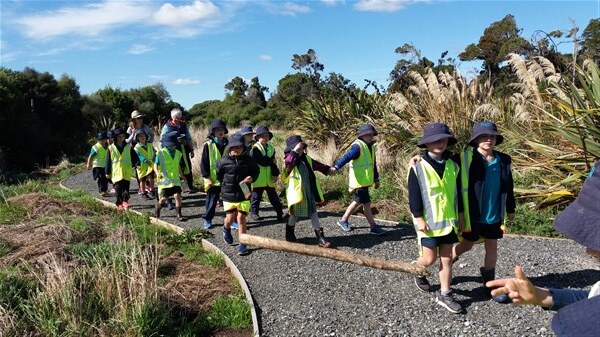
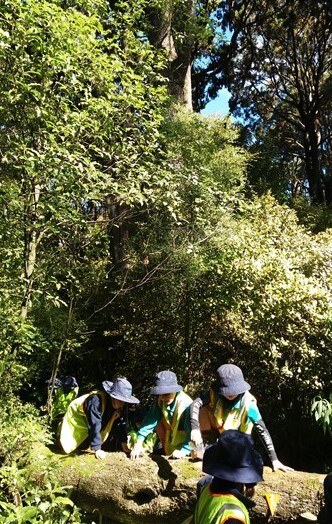
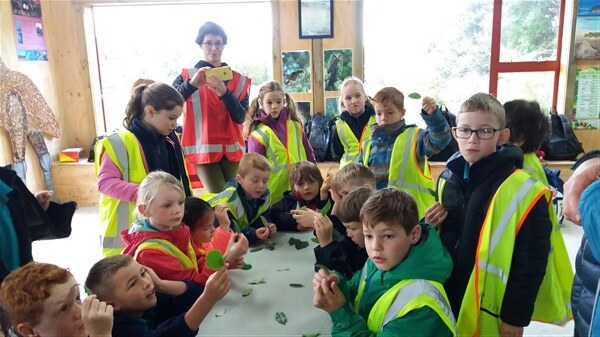
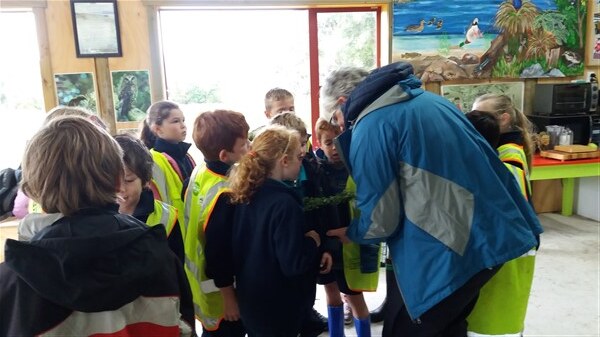
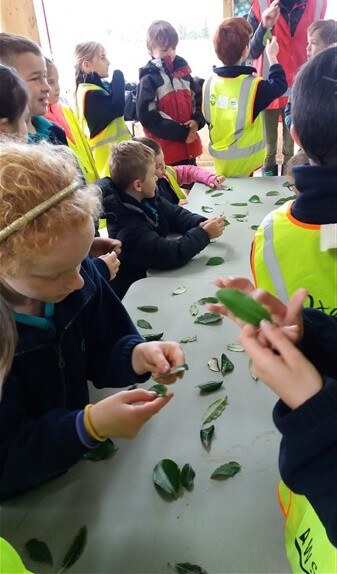
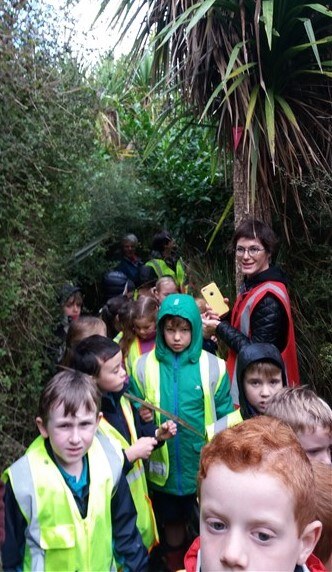
Seed hunting and great observational skills All the close observational work and drawings that this class had done back at school was evident as this class started by sharing with us what they already knew about the kahikatea. To learn more about the mighty kahikatea and other NZ native trees we started by looking closely at different tree leaves. We talked about the different names that kahikatea has - White pine (because of the whiteness of the wood inside the trunk) and Dacrydium dacrydioides - its scientific name meaning “tear shaped seed” and “like a conifer”. The highlight of the walk through the swampy kahikatea forest was finding heaps and heaps of kahikatea fruit, with the black round seed on the outside of the bright red/orange fruit. The students enjoyed collecting these, some to be taken back to the class for observational drawing and the rest for the nursery - thanks for contributing to the work that the community nursery undertakes. The observational skills of this group meant that we also saw tiny fungi, Pokaka seeds, the spores on the underside of fern fronds, ti kouka, shelf fungi, the piwakawaka that followed us, white faced heron feathers and the different smells of the forest. After singing “E tu Kahikatea” to the birds in the middle of the swamp forest we stood still and listened very quietly hearing tui and korimako (bellbird). This class was very very good at being silent. It was a great afternoon I the sunshine with a lovely class of budding botanists.
Bronwyn and Chris
Posted: 9 April 2019
Southland Girls have been having their Community Breakout days at Bushy Point since 2005. Day one saw the various groups plant 100 native plants and carefully covering each plant with combi-guards. The OLG team of Barry, Chris, Sally, Lesley and Ray helped run this activity. Mark Oster took groups on a bush adventure as only Mark can! Tom Harding introduced the girls to all things pesty! Pat Hoffman and Hannah Sim took two groups at a time to the Community Nursery Education Centre and Rances Garden where they studied “sustainability”. At lunchtime there was a commemorative planting in memory of the Christchurch atrocity, where a student planted three significant totara trees.
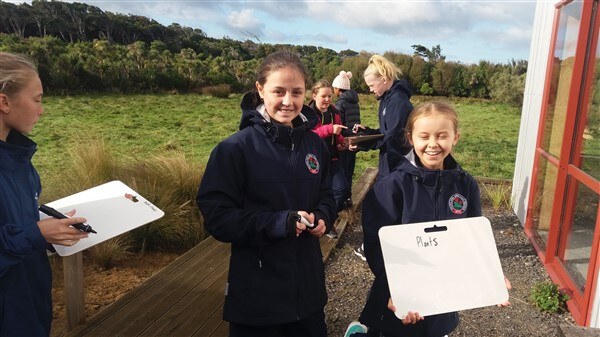
On day two Bronwyn joined in with the activities being run by ES for the SGHS year 7 group (today was the second day of such activities). Pat and Hannah brainstormed and played mind opening games around the concept of sustainability and what this means and looks like. The girls did a treasure hunt around the nursery area looking at what is being done in a sustainable way, giving them lots of ideas and the starting point to their thinking around how they can take some of these ideas back to SGHS and their school grounds. It will be great to hear what happens at SGHS.
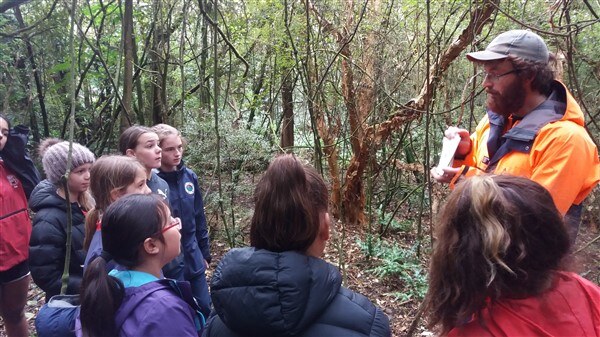
Then it was to Bushy Point where the group got to be in the NZ native bush (and for some this was their first time in the bush) learning all about how safe our bush is and looking at nests and then undertaking nest building for an imaginary 180 million year old stone bird! We had piwakawaka and korimako join us, and the totara forest gave a sheltered place for exploration and learning. After this fun with Mark, Tom took us along a pest line following the yellow markers. Animal pests were found, with some finds accompanied by loud shrieks. Possums, rats, stoats and other pests were looked at, a tracking tunnel was explained, some footprint identification was undertaken and a trap was studied to see how pests are killed. And we saw that it is not only animal pests that are a problem in our NZ forest, with Chilean flame creeper, a plant pest, seen and discussed.
The groups also did an environmental themed video making challenge with their teacher. A great day to be out in an area where the community is doing important planting, pest control and other valuable environmental work.
Chris and Bronwyn
Posted: 9 April 2019
A switched on group of learners from Year 3 Otatara School arrived ready and keen to learn all about their class tree Kotukutuku and much much more. A leaf identification game got the students observing and noticing similarities and differences between leaves, and what characteristics the kotukutuku leaf has – in terms of shape, colour (or colours as the the case is) and feel. We then talked about other identifying features that can be used to identify kotukutuku, like its bell like flower (that can be green, stripey, red or purple), its big black berries and its papery bark. It was then a discovery filled walk around the pond track, identifying numerous kotukutuku, noticing in what kind of places this tree likes to grow, what other native tree species are growing nearby, and what animals (in particular bugs) we could spot living in the habitats created by these plants. Spiders, slugs, shield bugs and more were spotted! We were too late in the season to find any flowers or berries, but we used our knowledge about and observation skills to spot the leaves and bark of the kotukutuku. We collected seeds from different plant species and noted how some are on the outside of a fruit, some are on the inside of a fruit, and some are in pods. We also noticed the ferns growing and how these have spores. A brilliant description of what spores are: “a pocket on the back of the leaf” was given summing up perfectly how there are many spores in each sporangium. A fantastic observation and descriptive explanation – tumeke! So many great terms to fill these eager minds with. Back in the education centre for some kai to feed these great inquiring minds we talked more about spores and looked closely at some fern fronds and just how small spores are. We also talked about those plants that attract birds – with kotukutuku being one of the best. Some great questioning led us onto talking about the animal pests that could be in the reserve behind school (we’d noticed all the different traps and bait stations as we explored through the nursery) and how we could track these to work out what is there, and then finding out about trapping. This class’s inquiring could go in a number of different, or many, directions and we look forward with much interest to have them visit again. Great to have you at the nursery Kotukutuku class.
Bronwyn and Chris
Posted: 9 April 2019
Sorry, the nursery is closed Friday 5 April 2019 as we are involved in the Native Plant Restoration Workshop. See you at the open morning Sunday 7 April or the following Friday.
Chris
Posted: 3 April 2019
We will be having an open day and plant sale on Sunday 7 April 2019 - 10am to noon. 185 Grant Road , Otatara
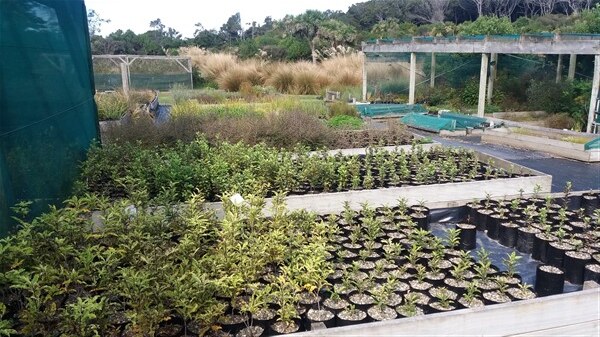
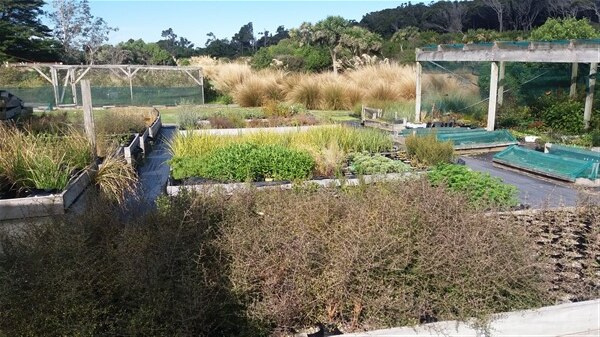
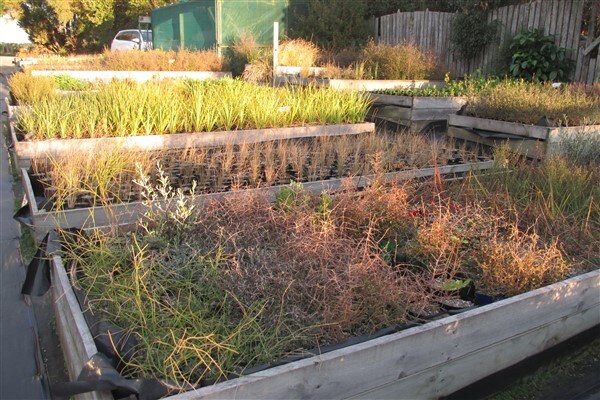
We have locally sourced, good sized plants in PB3’s ready for planting now – all $5 each – toetoe, Carex secta, mingimingi (Coprosma propinqua), Cabbage tree, Kohuhu (Pittosporum tenuifolium), wineberry, koromiko (Hebe salicifolia) Lemonwood, broadleaf, manuka, red tussock and a wide range of native shrubs. Sale of plants funds much of what we do at the Nursery and Education Centre so not only will you be getting good local plants, you will also be contributing to our Charitable Trust and the work we do with schools as well.
Phone Chris evenings 03 2131161 for further information or visit www.southlandcommunitynursery.org.nz
Don’t forget daylight saving!!
Chris
Posted: 3 April 2019