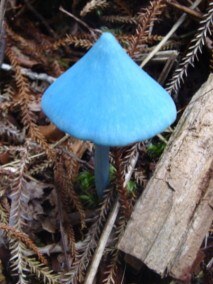
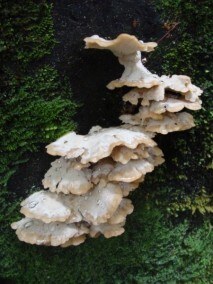
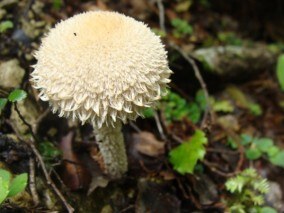
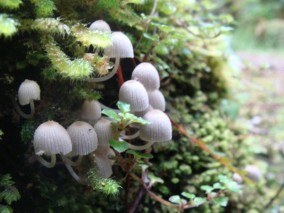
A recent trip revealed a number of interesting looking fungi. If you know what they are let me know by email.
Fungi mean its autumn - and the prime time for seed collecting in Southland. Come to the nursery on a Friday and see which seeds are ready for collection now.
Autumn is also a prime time for planting - the ground is nicely damp but the weather is still good enough to get plants established before winter sets in.
As a fundraiser for our new workshop/education centre we are now selling native pants for $5 a plant for PB3 size plants. Phone evenings 03 2131161 to arrange a suitable time to choose plants for your planting project.
Posted: 23 March 2012
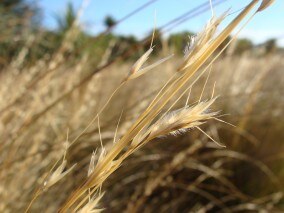
The month of February is the start of the seed collecting time for native plants in Southland. The first species are the grasses (e.g. red tussock - Chionochloa rubra or toe toe) and grass like species (e.g. Carex secta). The dry seed should be collected on a sunny day and put into paper bag, for sowing in winter. The seed can be expected to sprout the following spring - September ready for the new season. The seed looks like this when it is ready
It will be fluffy and will come off easily into your hand as you pull it through your fingers - if it doesnt come off the stalk easily then it is not ready yet. But….wait too long and the wind will blow it a way so keep a close eye on it!
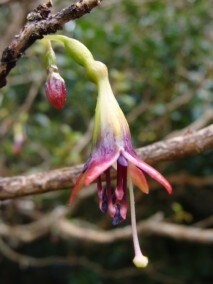
One of the first berries to ripen are the Fuchsia berries - large fruit that turn black when ready. They are favoured by birds so it is also a matter of good timing to get them before the birds do. Within the berry of Fuchsia are lots of tiny seeds so you only need to collect a few berries to have a lot of seeds to sow. To save this seed squash the berry onto kitchen paper and leave the tiny seeds to dry - put into a plastic bag to keep or sow.
Posted: 6 February 2012
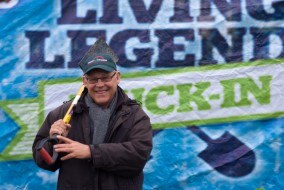
We are delighted to announce that “Bugman” Ruud Kleinpaste has recently joined the Community Nursery Trust as our Patron.
Ruud visited the nursery whilst attending the “Living Legends” event at Bushy Point in September 2011 and joined us to add his support to an exciting new venture that we are pursuing - a proposal to build an Education Centre adjoining the Community Nursery.
Watch this space!!
Posted: 6 February 2012
The Southland Community Nursery won the “plant nursery award” at the recent New Zealand Plant Conservation Network Awards.
NZPCN Newsletter - Trilepidia
“The awards recognise special people, and projects that have captured the interest of local communities. These individuals and groups are the leading guardians of our country’s native plants and ecosystems. They include Wanganui Intermediate School, a Southland plant nursery, a North Island city council, an island eco-sanctuary in the Hauraki Gulf, and dedicated plant enthusiasts and conservationists.
These awards are indicative of the huge effort that is being exerted all around the country by a large number of dedicated individuals, communities, and organisations to protect and enhance our unique native plants.
Plant Nursery
Southland Community Nursery, run by Chris and Brian Rance, won the ‘Plant Nursery Involved in Plant Conservation’ award for its unique approach to the growth, preservation and education of the public about native plant species. The nursery was nominated by three separate individuals. The nursery propagates local seeds and runs workshops through community groups and schools to teach volunteers the skills required to grow their own plants for restoration projects. The native plants grown at the nursery are planted all over Southland, on Council, Crown and privately owned property. The nursery is an invaluable resource for the province, with many schools using the nursery to teach children how to grow and care for native plants. There is a constant presence of long-time volunteers with a comprehensive knowledge base and new volunteers are regularly welcomed.
The nursery property features extensive restoration plantings linking mature kahikatea forest with shrubland and wetland. In addition, the nursery has established a Southland threatened plants garden to conserve and educate the public about threatened species and has developed a website providing information on restoration in Southland. This nursery is truly inspirational, having inspired many individuals, including the establishment of a similar Community Nursery in Bluff.”
www.nzpcn.org.nz
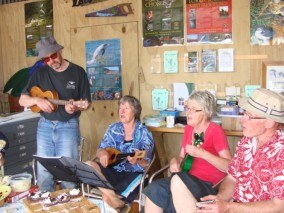
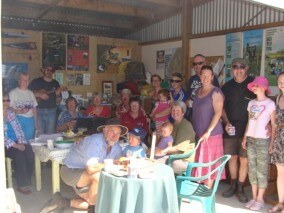
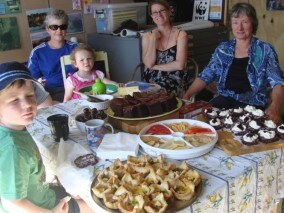
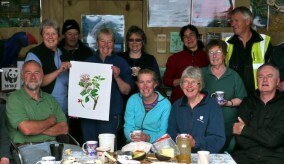
The Christmas break up at the nursery was well attended with the usual fantastic morning smoko and a special treat - ukulele carols with Geoff, Sherry, Maggie and Jeff.
Posted: 24 December 2011
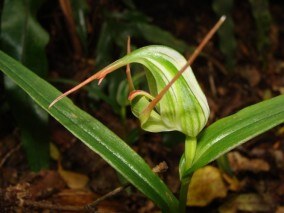
Native orchids are a very diverse group of plants and they can be seen at their best at this time of year. A few different orchids are illustrated here and if you are out and about in the bush or wetlands this holiday period keep your eyes peeled. In bush areas the most commonly seen orchid is the green hooded orchid (Pterostylis banksii) - this photo was taken at Mores Reserve Riverton on 23 December 2011.
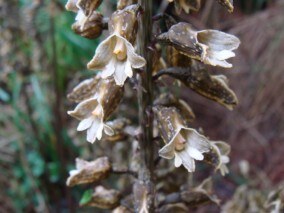
Also flowering now are the black orchids (Gastrodia cunninghamii), look out for what appears to be a dead stick!! They are parasitic orchids that grow on the roots of other plants and if you take a close look their flowers are quite distinctive, there are a lot of them up the stem and they are scented.
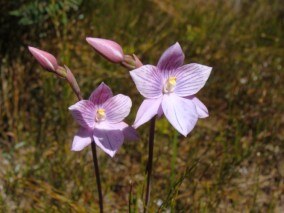
Some of the most spectacular orchids are found in wetlands. One such species is the sun orchid (Thelymitra vernosa). Its striking blue or purple colour is very obvious and this species can be seen at Waituna lagoon from the new loop track off Waghorn Road.
Posted: 24 December 2011